.png)

Gold-Backed IRA: How a Precious Metals IRA Works in 2026


Educational Disclosure: This article is provided by American Gold Group for general educational and informational purposes only. American Gold Group is a precious metals dealer and is not a financial advisor, investment advisor, tax advisor, retirement advisor, fiduciary, broker-dealer, or IRA custodian. Nothing in this article should be interpreted as financial, investment, tax, legal, or retirement advice. Individuals should consult their own qualified professionals regarding their specific circumstances.
A gold-backed IRA, commonly referred to as a Gold IRA or precious metals IRA, is a type of self-directed individual retirement account that can hold certain eligible physical precious metals.
Unlike many conventional retirement accounts that primarily hold securities such as stocks, bonds, or mutual funds, a self-directed IRA can provide access to a broader range of permitted assets, including certain forms of physical gold, silver, platinum, and palladium.
For people researching terms such as Gold IRA, gold-backed IRA, 401(k) to Gold IRA rollover, or self-directed precious metals IRA, understanding how the account is structured is an important first step.
What Is a Gold-Backed IRA?
A gold-backed IRA is generally established as a self-directed IRA through an independent IRA custodian.
The custodian administers the retirement account, maintains applicable records, processes transactions, and handles required reporting.
A precious metals dealer such as American Gold Group does not act as the IRA custodian.
Instead, the different parties involved generally have separate roles:
The IRA custodian administers the retirement account.
The precious metals dealer facilitates the purchase or sale of eligible metals.
The depository provides storage and custody of the physical metals.
This separation is one of the fundamental differences between purchasing physical precious metals personally and holding eligible metals within a retirement account.
How Does a Gold-Backed IRA Work?
Although individual circumstances may vary, a gold-backed IRA generally involves several steps.
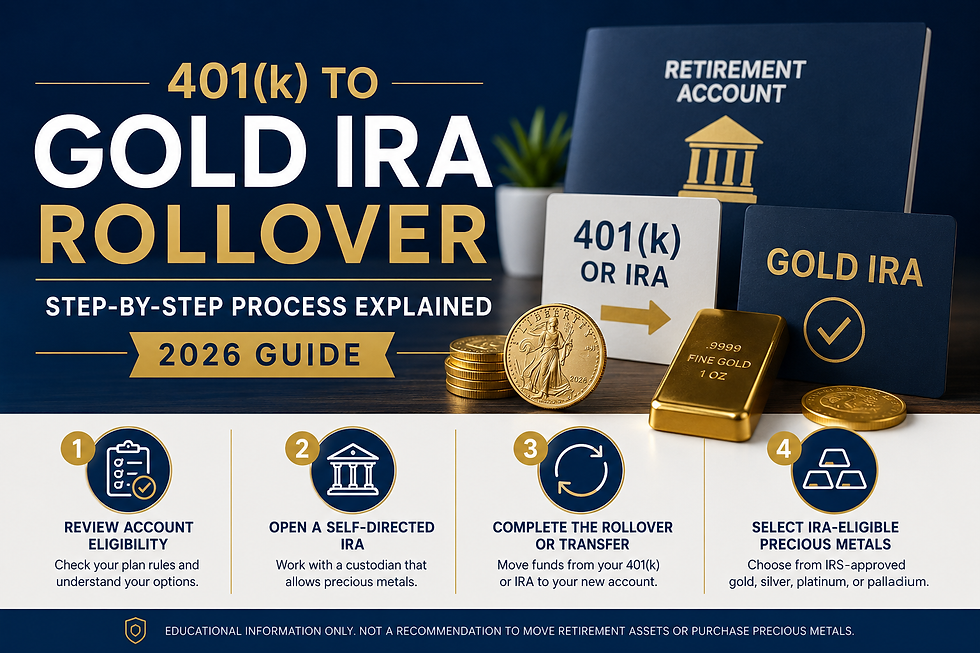
1. Establish a Self-Directed IRA
An individual typically begins by opening a self-directed IRA with a custodian that permits physical precious metals.
The IRA custodian provides the applicable account documentation and establishes the retirement account.
2. Fund the Account
A self-directed IRA may potentially be funded through several methods depending on the account and circumstances.
These can include:
An IRA-to-IRA transfer
A rollover from an eligible employer-sponsored retirement plan
An eligible contribution
Certain 401(k), 403(b), 457, TSP, Traditional IRA, SEP IRA, and other retirement accounts may potentially be eligible depending on the applicable plan rules and individual circumstances.
Eligibility should be confirmed directly with the retirement plan administrator or IRA custodian.
3. Select Eligible Precious Metals
Once funds are available within the self-directed IRA, the account owner can direct the purchase of eligible precious metals.
Not every gold or silver coin or bar qualifies for IRA ownership.
Certain precious metals must meet applicable eligibility and purity requirements.
Eligible products may include certain:
Gold bullion coins
Gold bullion bars
Silver bullion coins
Silver bullion bars
Platinum products
Palladium products
The IRA custodian can provide information regarding account requirements and permitted assets.
4. Metals Are Sent to an Approved Depository
Precious metals held within an IRA are generally stored through an approved depository rather than being personally stored by the IRA owner while they remain within the retirement account.
The depository is responsible for the physical custody and storage of the metals.
Storage arrangements and associated fees can vary depending on the custodian and depository selected.
5. The Custodian Continues to Administer the Account
Once the metals are held within the IRA, the independent custodian continues to administer the retirement account.
This may include account statements, transaction records, reporting, and coordination with the depository.
American Gold Group does not administer retirement accounts.
Gold IRA Rollover vs. IRA Transfer
Two terms frequently encountered when researching a gold-backed IRA are rollover and transfer.
Although they are sometimes used interchangeably in everyday conversation, they can describe different processes.
IRA Transfer
An IRA transfer generally involves moving funds directly from one IRA custodian to another.
Retirement Account Rollover
A rollover may involve moving eligible retirement funds from an employer-sponsored plan, such as a 401(k), into an IRA.
The procedures and requirements can vary depending on the type of retirement account and how the transaction is structured.
Individuals should obtain instructions directly from the custodians or retirement plan administrators involved before initiating a transfer or rollover.
Can a 401(k) Be Rolled Over Into a Gold IRA?
Certain 401(k) plans may potentially be eligible for rollover into a self-directed IRA that allows precious metals.
Whether a particular 401(k) can be rolled over depends on several factors, including:
The type of retirement plan
Current or former employment status
The plan’s distribution rules
The requirements of the receiving IRA custodian
The plan administrator or IRA custodian should determine whether a particular account is eligible.
What Precious Metals Can Be Held in a Gold IRA?
Gold-backed IRAs are not limited exclusively to gold.
Depending on eligibility requirements, certain forms of:
Gold
Silver
Platinum
Palladium
may potentially be held within a self-directed precious metals IRA.
However, not every precious metals product qualifies.
Collectible coins, rare coins, and other products may be subject to different rules and should not automatically be assumed to qualify for IRA ownership.
Where Is Gold in an IRA Stored?
Physical precious metals held within an IRA are generally stored at an approved depository.
The account owner does not typically take personal possession of the metals while they remain within the IRA.
Depositories may offer different storage arrangements, and storage fees can vary.
Individuals should review the applicable custodian and depository agreements before establishing an account.
Can Gold Be Taken Out of a Gold IRA?
An IRA owner may potentially request a distribution from a precious metals IRA.
Depending on the circumstances, a distribution may involve either:
Liquidating metals and distributing funds, or
Distributing physical precious metals
Retirement-account distributions can have tax consequences and may be subject to applicable rules and penalties.
American Gold Group does not provide tax or retirement advice. Individuals considering a distribution should consult their IRA custodian and qualified tax professionals.
Gold-Backed IRA vs. Buying Physical Gold
A gold-backed IRA and a direct physical precious metals purchase are different structures.
Gold-Backed IRA
With a gold-backed IRA:
Metals are held inside a retirement account.
An independent custodian administers the account.
Metals are generally stored at an approved depository.
Retirement-account rules apply.
Direct Physical Gold Purchase
With a direct physical purchase:
Metals are purchased outside of a retirement account.
The purchaser determines how the metals will be delivered or stored.
IRA custody requirements generally do not apply.
American Gold Group offers both precious metals transactions associated with self-directed IRAs and direct physical precious metals purchases.
What Costs Can Be Associated With a Gold IRA?
Gold-backed IRAs can involve several different types of costs.
Depending on the companies involved, these may include:
Precious metals dealer spreads or premiums
IRA custodian fees
Account administration fees
Depository storage fees
Transaction-related charges
Shipping or handling expenses where applicable
Precious metals are purchased and sold at different prices, and market values fluctuate.
Customers should review applicable pricing and fee disclosures before completing a transaction.
What Happens When Precious Metals in an IRA Are Sold?
An IRA owner may direct the sale of some or all precious metals held within the account.
The applicable custodian and depository coordinate the retirement-account procedures, while a precious metals dealer may provide pricing for the metals being sold.
When metals are liquidated within an IRA, proceeds are generally returned to the retirement account unless the account owner directs an authorized distribution.
The specific process can vary depending on the custodian and account structure.
Why Do People Research Gold-Backed IRAs?
People research gold-backed IRAs for many different reasons.
Some want to understand the types of assets permitted within a self-directed IRA.
Others are comparing physical precious metals held personally with metals held through a retirement account.
Common searches include:
What is a Gold IRA?
How does a gold-backed IRA work?
Can I roll over a 401(k) to a Gold IRA?
What metals are allowed in a precious metals IRA?
Where is Gold IRA metal stored?
What is the difference between a Gold IRA rollover and transfer?
Understanding the mechanics of the account, the role of the custodian, storage requirements, pricing, and applicable retirement-account procedures can help individuals ask better questions before completing a transaction.

Learn More From American Gold Group
Continue learning about Gold IRAs, retirement-account rollovers, and physical precious metals:
Important Disclosure
American Gold Group Services, LLC is an independent precious metals dealer. American Gold Group is not a financial advisor, investment advisor, tax advisor, retirement advisor, fiduciary, broker-dealer, or IRA custodian.
Information provided by American Gold Group is for general educational and informational purposes only and should not be interpreted as financial, investment, tax, legal, or retirement advice.
Precious metals prices fluctuate and may rise or fall. Precious metals transactions may include dealer spreads, premiums, storage fees, custodian fees, administrative fees, and other transaction-related costs.
Retirement accounts are administered by independent third-party custodians and are subject to applicable rules and requirements. Individuals should consult their own qualified financial, tax, legal, or retirement professionals regarding their individual circumstances before making decisions involving retirement accounts.


Comments