.png)

How Are Funds Transferred Into a Gold IRA?

Updated: Aug 16
Educational Disclosure: This article is provided for general educational purposes only. American Gold Group Services, LLC is an independent precious metals dealer and is not a financial advisor, investment advisor, tax advisor, fiduciary, broker-dealer, or IRA custodian. American Gold Group does not provide investment, tax, legal, or retirement advice. Individuals should consult their own qualified professionals regarding their circumstances.
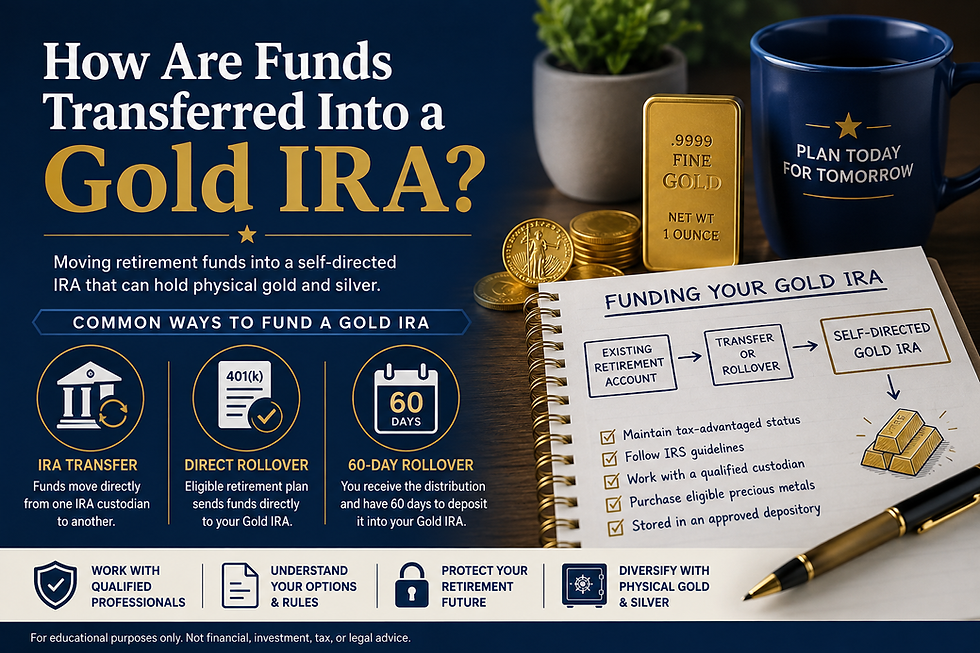
If you are researching how funds are transferred into a Gold IRA, it is important to understand that there is more than one way retirement assets may potentially be moved into a self-directed IRA that permits eligible precious metals.
Depending on the type of retirement account involved, funds may be moved through an IRA-to-IRA transfer, a direct rollover from an employer-sponsored retirement plan, or in certain situations, a 60-day rollover.
These processes are not necessarily the same, and the procedures can vary depending on the existing retirement account, the receiving IRA custodian, the plan administrator, and applicable rules.
Here is a closer look at how the Gold IRA funding process generally works.
What Does It Mean to Transfer Funds Into a Gold IRA?
A Gold IRA generally refers to a self-directed individual retirement account that permits certain qualifying physical precious metals to be held within the account.
Before IRA-owned precious metals can be acquired, the self-directed IRA must first have funds available for the transaction.
Depending on the circumstances, those funds may potentially come from an existing IRA, an eligible employer-sponsored retirement account, or an eligible IRA contribution.
When existing retirement assets are involved, the method used to move the funds depends largely on the type of account from which the assets are coming.
How Are Funds Transferred Into a Gold IRA?
The process generally begins by establishing a self-directed IRA with a custodian that supports precious metals transactions.
Once the account has been established, the account owner can work with the receiving custodian and, when applicable, the existing IRA provider or retirement plan administrator to initiate the appropriate funding process.
A typical process may involve:
Establishing the self-directed IRA.
Identifying the retirement account from which funds may be moved.
Determining whether the transaction will be structured as a transfer or rollover.
Completing the required custodian or plan documentation.
Having the applicable financial institution or plan process the movement of funds.
Confirming that the funds have been received by the new self-directed IRA.
After funding, reviewing eligible precious metals available for purchase through a precious metals dealer.
The exact procedures can vary considerably between financial institutions and retirement plans.
IRA-to-IRA Transfer
If funds are being moved from an existing IRA into another IRA, the transaction may potentially be completed as a trustee-to-trustee transfer.
In a trustee-to-trustee transfer, the existing IRA trustee or custodian sends the funds directly to the receiving IRA trustee or custodian.
Because the funds move between the financial institutions rather than being distributed to the account owner, the IRS treats this differently from a rollover in which an individual receives a distribution.
The receiving self-directed IRA custodian generally provides instructions and documentation for initiating the transfer.
What Is a Direct Gold IRA Rollover?
When funds originate from an eligible employer-sponsored retirement plan, such as certain 401(k) accounts, the transaction may potentially be completed through a direct rollover.
In a direct rollover, the retirement plan sends the eligible distribution directly to the receiving IRA rather than paying the funds directly to the individual.
Depending on the procedures of the plan administrator and receiving custodian, the funds may be transmitted electronically or a check may be issued payable to the receiving IRA or custodian for the benefit of the account owner.
The specific procedures depend on the institutions involved.
Can a 401(k) Be Rolled Over Into a Gold IRA?
Certain 401(k) assets may potentially be eligible for rollover into an IRA.
Eligibility depends on the retirement plan and the individual’s circumstances.
For example, an individual with a 401(k) from a previous employer may have different distribution options than someone attempting to move assets from a plan maintained by a current employer.
Employer-sponsored plans have their own rules governing when distributions and rollovers are permitted.
For this reason, individuals should verify eligibility with the existing plan administrator and receiving IRA custodian before initiating a 401(k) to Gold IRA rollover.
Can an IRA Be Transferred Into a Gold IRA?
Certain existing IRA assets may potentially be transferred to a self-directed IRA that permits eligible precious metals.
When an IRA-to-IRA transaction is structured as a trustee-to-trustee transfer, the funds generally move directly between the IRA trustees or custodians.
The receiving custodian can provide the necessary transfer documentation and explain its procedures for receiving the funds.
What Is a 60-Day Rollover?
Another method of moving certain retirement assets is generally referred to as a 60-day rollover.
Unlike a direct rollover or trustee-to-trustee transfer, a 60-day rollover involves a retirement distribution being paid to the individual.
The individual generally has 60 days after receiving an eligible distribution to deposit the applicable amount into another eligible retirement plan or IRA.
Because this type of transaction involves the individual receiving the distribution, different withholding, reporting, timing, and rollover rules may apply.
Individuals considering this type of transaction should verify the applicable requirements with the retirement plan administrator, IRA custodian, and their own qualified tax professional before proceeding.
Is a Gold IRA Transfer the Same as a Gold IRA Rollover?
Not necessarily.
Although the terms Gold IRA transfer and Gold IRA rollover are sometimes used interchangeably in everyday conversation, they can describe different methods of moving retirement assets.
An IRA-to-IRA trustee-to-trustee transfer generally involves funds moving directly from one IRA trustee or custodian to another.
A direct rollover generally involves an eligible distribution from an employer-sponsored retirement plan being sent directly to another eligible retirement plan or IRA.
A 60-day rollover generally involves an eligible distribution being paid to the individual, who then deposits the applicable amount into another eligible retirement arrangement within the required time period.
Understanding which transaction is actually being used is important because different procedures and rules may apply.
What Types of Retirement Accounts May Be Eligible?
Depending on applicable rules, plan provisions, and individual circumstances, retirement accounts that may potentially be involved in transfers or rollovers can include certain:
Traditional IRAs
SEP IRAs
SIMPLE IRAs, subject to applicable rules
401(k) plans
403(b) plans
Governmental 457(b) plans
Thrift Savings Plan accounts
Other eligible retirement arrangements
Eligibility should not be assumed based solely on the type of account.
The existing plan administrator or IRA provider and receiving custodian can provide information regarding whether a particular transaction is permitted.
How Does a Gold IRA Transfer From a Previous Employer’s 401(k) Work?
A former-employer 401(k) is one type of retirement account that individuals commonly research when learning about Gold IRA rollovers.
If the applicable assets are eligible for distribution and rollover, the process generally begins by establishing the receiving self-directed IRA.
The account owner can then contact the former employer’s plan administrator to determine the plan’s rollover procedures.
If a direct rollover is selected and permitted, the plan generally sends the eligible funds directly to the receiving IRA according to the plan’s procedures.
Once the funds have been received and made available in the self-directed IRA, the account owner can determine whether to authorize a precious metals transaction.
What About a Current Employer’s 401(k)?
A current-employer 401(k) may operate differently.
Employer-sponsored retirement plans establish rules regarding when participants may take distributions or move assets from the plan.
Some plans may permit certain distributions while an individual is still employed, while others may restrict them.
Whether a current 401(k) can be rolled over therefore depends on the particular plan and the participant’s circumstances.
The plan administrator should be contacted to determine what options are available under the specific plan.
How Long Does a Gold IRA Transfer Take?
There is no universal timeline for a Gold IRA transfer or rollover.
Processing time can depend on:
The existing IRA provider or retirement plan administrator
The receiving self-directed IRA custodian
The type of retirement account
Whether the transaction is a transfer or rollover
Required paperwork
Identity-verification procedures
How the funds are transmitted
Whether additional information is required
Because multiple independent institutions can be involved, processing times should generally be considered transaction-specific rather than guaranteed.
What Happens After the Funds Reach the Gold IRA?
Funding the self-directed IRA and purchasing precious metals are separate parts of the process.
Once funds have been received and made available by the IRA custodian, the account owner may review precious metals that satisfy applicable IRA requirements.
If the account owner chooses to proceed with a precious metals transaction, the account owner selects the eligible products and authorizes the transaction.
The precious metals dealer then coordinates the transaction with the IRA custodian according to the applicable procedures.
American Gold Group acts as the precious metals dealer and does not serve as the IRA custodian or trustee.
How Are Precious Metals Purchased After the Transfer?
After the self-directed IRA has available funds, the account owner can review eligible precious metals offered by a precious metals dealer.
Not every gold or silver product is eligible to be held through an IRA.
The selected precious metals must satisfy applicable requirements for IRA ownership.
Once a transaction has been authorized, the IRA custodian generally processes payment according to its procedures, and the qualifying precious metals are delivered according to the applicable custody and storage arrangement.
Does American Gold Group Hold the Retirement Funds?
No.
American Gold Group is an independent precious metals dealer and does not act as an IRA custodian or trustee.
Retirement account administration and the movement of retirement funds are handled through the applicable IRA custodian, trustee, financial institution, or retirement plan administrator.
American Gold Group’s role is separate. American Gold Group provides educational information regarding precious metals and facilitates precious metals transactions at the direction of its clients.
Who Is Involved in a Gold IRA Transfer or Rollover?
Several independent parties may be involved in the process.
Account Owner: Authorizes the applicable transactions.
Existing IRA Provider or Retirement Plan Administrator: Processes the transfer, distribution, or rollover according to the applicable account or plan procedures.
Receiving IRA Custodian: Establishes and administers the self-directed IRA and processes transactions according to its procedures.
Precious Metals Dealer: Provides information regarding available precious metals and facilitates a precious metals transaction at the account owner’s direction.
Storage Provider: Provides storage for IRA-owned precious metals according to the applicable custody arrangement.
These parties perform different functions within the process.
Are Taxes Automatically Due When Funds Are Moved?
The tax treatment of retirement-account transactions depends on the type of transaction, the accounts involved, how the movement of funds is structured, and the individual’s circumstances.
For example, the IRS distinguishes between trustee-to-trustee IRA transfers, direct rollovers, and distributions paid directly to an individual.
Certain distributions paid directly to an individual may also be subject to withholding requirements.
Because individual circumstances differ, American Gold Group does not determine the tax consequences of a transfer or rollover.
Individuals should verify applicable requirements with their IRA custodian, plan administrator, and qualified tax professional.
Are There Limits on IRA Rollovers?
Certain rollover limitations can apply depending on the transaction.
For example, IRS rules generally limit certain IRA-to-IRA rollovers involving distributions paid to an individual to one within a 12-month period.
However, the IRS states that the one-rollover-per-year limitation does not apply to trustee-to-trustee transfers between IRAs.
Because these distinctions can affect how a transaction is treated, individuals should confirm the appropriate process with the applicable custodian or qualified professional.
Can Part of a Retirement Account Be Moved?
Whether all or part of an account can be transferred or rolled over depends on the type of retirement account, the particular plan, distribution eligibility, and the procedures of the institutions involved.
Individuals considering a partial transfer or rollover should verify availability and requirements with the existing retirement account provider and receiving custodian.
Questions to Ask About the Transfer Process
When researching how funds are transferred into a Gold IRA, useful factual questions can include:
Is the existing retirement account eligible for a transfer or rollover?
Does the receiving custodian support self-directed precious metals IRAs?
Is the transaction considered a transfer or rollover?
What paperwork is required?
How will the funds be transmitted?
What processing times does each institution generally have?
Are there custodian or account fees?
What storage arrangements are available?
Which precious metals satisfy the applicable IRA requirements?
What procedures apply if precious metals are later sold or distributed?
Obtaining this information can help clarify the mechanics, costs, and parties involved in the transaction.
Frequently Asked Questions About Transferring Funds Into a Gold IRA
How do I transfer money from an IRA to a Gold IRA?
An IRA-to-IRA transaction may potentially be completed through a trustee-to-trustee transfer in which the existing IRA provider sends funds to the receiving self-directed IRA custodian. Procedures vary by custodian.
How do I move a 401(k) into a Gold IRA?
If the 401(k) assets are eligible for rollover, a self-directed IRA can first be established and the applicable rollover procedures coordinated with the 401(k) plan administrator and receiving IRA custodian.
Does the money go directly to the gold dealer?
Generally, retirement account funds are administered through the IRA custodian or trustee. The precious metals dealer performs a separate role in facilitating an authorized precious metals transaction.
Can I receive the retirement money personally and then deposit it into an IRA?
Certain eligible distributions may qualify for a 60-day rollover. However, specific timing, withholding, reporting, and eligibility requirements can apply when funds are paid directly to an individual.
Is an IRA transfer the same as a rollover?
No. A trustee-to-trustee transfer between IRAs is treated differently from certain rollover transactions.
Can funds be transferred before selecting the gold?
The self-directed IRA can generally be funded before an account owner determines whether to authorize a precious metals transaction. Funding the IRA and purchasing precious metals are separate steps.
Understanding How Funds Are Transferred Into a Gold IRA
There is not a single method used for every Gold IRA transaction.
Depending on the retirement accounts involved, funds may potentially be moved through an IRA-to-IRA trustee-to-trustee transfer, a direct rollover from an eligible employer-sponsored retirement plan, or in certain situations, a 60-day rollover.
The appropriate process depends on the existing account, eligibility, applicable rules, and the procedures of the financial institutions involved.
American Gold Group provides educational information regarding precious metals and facilitates precious metals transactions at the direction of its clients.
American Gold Group does not determine whether a transfer, rollover, Gold IRA, or precious metals purchase is appropriate for any individual.

Learn More From American Gold Group
Important Disclosure: American Gold Group Services, LLC is an independent precious metals dealer and is not a financial advisor, investment advisor, tax advisor, fiduciary, broker-dealer, or IRA custodian. American Gold Group does not provide investment, tax, legal, or retirement advice. Precious metals prices fluctuate and may involve risk. Product pricing may include dealer spreads, premiums, administrative costs, and other transaction-related expenses. Transactions involving retirement accounts are administered by independent third-party custodians and may be subject to additional rules and requirements. Individuals should consult their own qualified professionals regarding their individual circumstances.


Comments