.png)

What Is a Self-Directed Gold IRA? How It Works in 2026

Updated: Sep 2
Updated for 2026
A self-directed Gold IRA is an individual retirement account that can hold certain physical precious metals when applicable IRS requirements are followed.
The term “self-directed” can sometimes cause confusion. It does not mean that the IRA owner personally holds the metals or bypasses the IRA custodian. Instead, a self-directed IRA generally provides access to a broader range of permitted assets than many conventional IRA custodians make available.
When physical precious metals are held through an IRA, several parties may be involved, including the IRA owner, a self-directed IRA custodian or trustee, a precious-metals dealer, and an eligible storage facility.
This guide explains how a self-directed Gold IRA works, the roles of the different parties involved, and some of the IRS rules that apply.


Important: This article is provided for general educational purposes only. American Gold Group is a precious-metals dealer and is not a financial advisor, tax advisor, IRA custodian, or plan administrator. American Gold Group does not determine whether a retirement account is eligible for a rollover or transfer and does not provide financial, investment, legal, or tax advice. Questions regarding individual eligibility, tax consequences, or retirement-account rules should be discussed with the appropriate plan administrator, IRA custodian, tax professional, or other qualified professional.
What Is a Self-Directed IRA?
A self-directed IRA, often abbreviated as SDIRA, is an IRA administered by a custodian or trustee that permits certain assets beyond those commonly available through traditional brokerage-based IRAs.
The underlying account is still an IRA and remains subject to applicable federal rules.
“Self-directed” primarily describes the account owner’s ability to direct the custodian regarding permitted transactions within the account. It does not eliminate the role of the IRA custodian or the rules governing IRA assets.
Depending on the custodian and account structure, self-directed IRAs may permit various types of assets. When an SDIRA holds qualifying physical precious metals, it is commonly referred to as a self-directed Gold IRA or precious metals IRA.
What Is a Self-Directed Gold IRA?
A self-directed Gold IRA is a self-directed IRA structured to hold certain physical precious metals that meet applicable requirements.
Despite the name “Gold IRA,” qualifying accounts may be able to hold more than gold. Certain silver, platinum, and palladium products may also qualify when applicable requirements are satisfied.
Not every gold coin, silver coin, or bullion product can be placed in an IRA.
Federal law generally treats metals and coins as collectibles, but provides exceptions for certain coins and certain gold, silver, platinum, and palladium bullion meeting specified requirements.

How Does a Self-Directed Gold IRA Work?
Although circumstances vary by custodian and account type, a precious-metals IRA generally involves several separate parties.
1. The IRA Owner
The account owner establishes the IRA with a custodian or trustee that permits the type of precious-metals transaction being considered.
The account owner can generally provide direction regarding permitted transactions, subject to the custodian’s procedures and applicable rules.
2. The Self-Directed IRA Custodian or Trustee
The IRA custodian or trustee administers the account.
Depending on the arrangement, the custodian may process transactions, maintain account records, provide required reporting, coordinate permitted distributions, and carry out other administrative functions.
American Gold Group is not an IRA custodian or trustee.
3. The Precious-Metals Dealer
A precious-metals dealer facilitates the purchase or sale of metals.
When an IRA purchase is properly authorized, the custodian generally sends funds according to its procedures, and the dealer provides the metals involved in the transaction.
American Gold Group’s role is as a precious-metals dealer. It does not determine whether an IRA transaction is appropriate for an individual.
4. Storage of the Metals
Physical possession and storage rules are an important distinction between purchasing precious metals personally and holding qualifying bullion through an IRA.
Qualifying IRA bullion generally must remain in the physical possession of a bank or an approved nonbank trustee as required under applicable federal rules.
IRA owners considering precious metals should confirm applicable custody and storage requirements directly with their IRA custodian or other qualified professional.
Does “Self-Directed” Mean You Can Keep the Gold at Home?
No. The phrase self-directed Gold IRA should not be interpreted as meaning that an IRA owner can simply purchase IRA bullion and store it personally.
IRS guidance states that qualifying bullion must be in the physical possession of a bank or an IRS-approved nonbank trustee.
Taking personal possession or engaging in transactions that do not comply with applicable IRA rules can create significant tax consequences.
Individuals with questions about possession, storage, distributions, or prohibited transactions should consult their IRA custodian and an appropriate tax or legal professional.
What Precious Metals Can a Self-Directed Gold IRA Hold?
Federal law provides exceptions to the general collectible restrictions for certain coins and qualifying bullion.
Depending on the particular product and applicable requirements, an IRA may be permitted to hold certain:
Gold
Silver
Platinum
Palladium
Eligibility depends on the specific coin or bullion product and the applicable statutory requirements.
The fact that a product is made from gold or another precious metal does not automatically make it IRA eligible.
Before an IRA transaction is completed, eligibility of a particular product should be confirmed through the IRA custodian or other appropriate professional.

Are All Gold Coins Allowed in a Gold IRA?
No.
The IRS rules governing collectibles contain specific exceptions, but not every gold coin qualifies for those exceptions.
This distinction is particularly important because the general rule treats many coins and metals as collectibles.
For that reason, the eligibility of a specific coin or bullion product should be established before it is acquired by an IRA.
Self-Directed Gold IRA vs. a Conventional IRA
One of the primary differences involves the types of assets the IRA custodian makes available.
A conventional IRA maintained through a brokerage firm may offer assets such as stocks, bonds, mutual funds, or exchange-traded funds.
A self-directed IRA custodian may permit additional asset categories, including qualifying physical precious metals.
Both remain retirement accounts and are subject to applicable IRA rules.
The term “self-directed” does not create a separate tax category of IRA and does not exempt an account from federal retirement-account requirements.
Can an Existing IRA Be Transferred to a Self-Directed Gold IRA?
Depending on the accounts involved and the custodian’s requirements, assets may sometimes be moved between eligible IRA accounts through an IRA-to-IRA transfer.
The specific process depends on the account types and custodians involved.
American Gold Group does not determine transfer eligibility. Account owners should confirm the available process and any applicable requirements directly with the custodians involved.
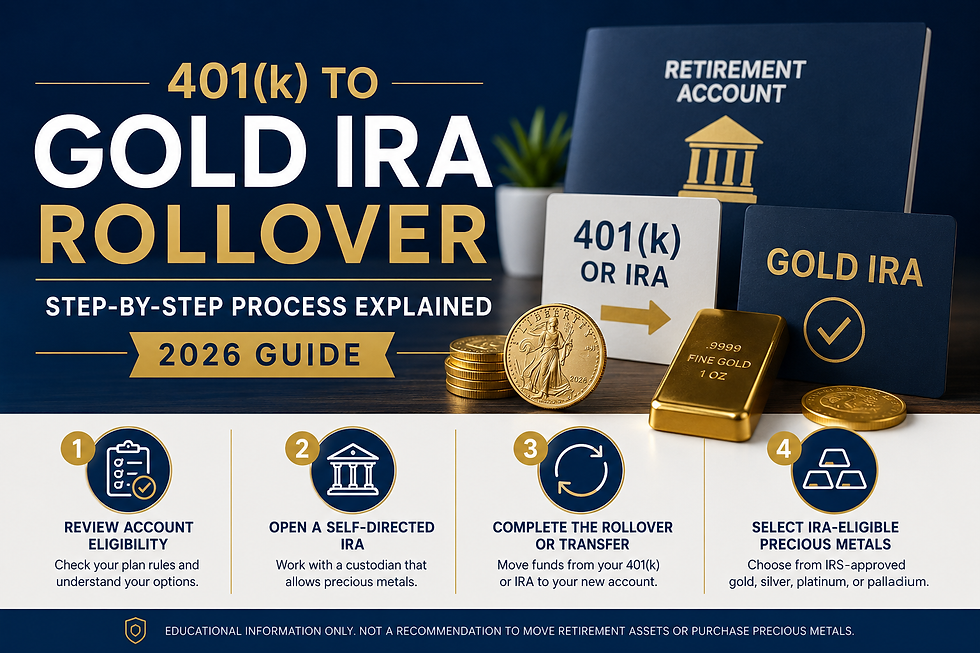
Can a 401(k) Be Rolled Into a Self-Directed Gold IRA?
Certain distributions from employer-sponsored retirement plans may be eligible for rollover treatment, depending on the plan, employment status, distribution type, and other circumstances.
Eligibility is not determined by the precious-metals dealer.
Someone considering a 401(k) to Gold IRA rollover should first confirm rollover eligibility and procedures with the existing plan administrator and receiving IRA custodian.
Are There Prohibited Transactions With a Self-Directed IRA?
Yes.
Self-directed IRAs remain subject to prohibited-transaction rules.
Examples identified in IRS guidance include certain transactions involving the improper use of IRA assets by the IRA owner, beneficiaries, or other disqualified persons.
Because a prohibited transaction can have significant consequences for an IRA, questions about a particular transaction should be directed to a qualified tax or legal professional and the IRA custodian.

Who Controls a Self-Directed Gold IRA?
The word “self-directed” describes the account owner’s ability to direct permitted transactions, but several parties can have distinct responsibilities.
The IRA owner provides direction regarding permitted transactions.
The IRA custodian or trustee administers the account and carries out authorized transactions according to its procedures.
The precious-metals dealer handles the purchase or sale of metals.
The eligible storage provider or trustee maintains physical custody of the metals as required by the applicable arrangement and rules.
Understanding these separate roles can help explain why a self-directed Gold IRA is different from personally purchasing gold for direct delivery.
Is a Self-Directed Gold IRA the Same as Buying Physical Gold?
No.
Purchasing physical gold personally and acquiring qualifying precious metals through an IRA are different transactions.
With a personal precious-metals purchase, the purchaser generally takes possession or arranges personal storage.
With qualifying precious metals held through an IRA, the assets are owned within the IRA and are subject to applicable IRA custody, transaction, and distribution rules.
These distinctions are important when researching Gold IRAs versus physical gold ownership.
What Happens When Metals Are Sold Inside a Gold IRA?
When metals held by an IRA are sold, the transaction generally takes place through the IRA structure, and proceeds are returned to the IRA according to the custodian’s procedures.
Selling metals within an IRA should not be confused with taking a distribution from the IRA.
Distribution and tax rules depend on the account and individual circumstances. Questions regarding tax treatment should be directed to the IRA custodian or a qualified tax professional.
What Happens When Metals Are Distributed From a Gold IRA?
IRA distributions are subject to applicable retirement-account and tax rules.
Depending on the custodian, account type, and circumstances, different distribution procedures may be available.
Because tax treatment can vary, American Gold Group does not provide tax advice regarding IRA distributions. Account owners should consult their custodian and an appropriate tax professional regarding their individual circumstances.
Frequently Asked Questions
Is a Gold IRA a self-directed IRA?
Physical precious metals held within an IRA are generally administered through a custodian or trustee that permits these types of assets. These accounts are commonly described as self-directed Gold IRAs or precious metals IRAs.
Does self-directed mean I personally store my IRA gold?
No. “Self-directed” refers to directing permitted transactions within the IRA. IRS rules impose separate custody requirements for qualifying bullion held by an IRA.
Can a self-directed Gold IRA hold silver?
Certain qualifying silver, platinum, and palladium products may also be permitted, subject to applicable requirements.
Can any IRA custodian hold physical gold?
No. Custodians may impose their own restrictions on the assets they will administer. An IRA custodian must permit the particular type of transaction involved.
Is every gold bar eligible for an IRA?
No. The specific bullion must satisfy applicable requirements. The eligibility of a particular product should be confirmed before an IRA acquisition.
Is American Gold Group an IRA custodian?
No. American Gold Group is a precious-metals dealer. It does not serve as an IRA custodian, trustee, financial advisor, tax advisor, or plan administrator.
Understanding the Self-Directed Gold IRA Process
A self-directed Gold IRA is an IRA that permits certain qualifying physical precious metals to be held within the account under applicable rules.
The account remains subject to IRA requirements, and “self-directed” does not mean that the owner can disregard custodian, storage, distribution, or prohibited-transaction rules.
Before establishing or moving assets into any IRA, individuals should verify account eligibility, procedures, and potential tax consequences with their existing plan administrator, IRA custodian, and appropriate professional advisors.
American Gold Group can provide factual information about precious-metals products and the dealer’s role in transactions involving eligible metals.

Schedule a Call
Have questions after reading this article? Schedule a convenient time to speak with an American Gold Group representative about the general Gold IRA and precious metals process.
Learn More About Self-Directed Gold IRAs
Continue exploring how self-directed Gold IRAs, rollovers, retirement-account eligibility, and precious-metals custody work:
These resources are provided for general educational purposes and explain different aspects of self-directed IRAs and precious-metals transactions. Eligibility, rollover procedures, custody requirements, and tax treatment can depend on the account and individual circumstances.

Disclosure: American Gold Group is a precious-metals dealer and is not a financial advisor, investment advisor, tax advisor, IRA custodian, trustee, or plan administrator. Information provided by American Gold Group is for general educational purposes only and should not be considered financial, investment, legal, or tax advice. Precious metals prices can rise or fall, and precious metals involve risk. Eligibility for IRA rollovers, transfers, specific precious-metals products, storage arrangements, distributions, and tax treatment depends on individual circumstances and applicable rules. Consult the appropriate plan administrator, IRA custodian, tax professional, legal professional, or other qualified professional regarding your individual circumstances.

Comments