.png)

Can You Roll Over a 401(k) From a Previous Employer Into a Gold IRA? — 2026 Guide
Updated: Sep 2
If you have a 401(k) from a previous employer, you may be researching what options are available for that account and whether an eligible distribution can be rolled over to an IRA that permits certain physical precious metals.
In many circumstances, an eligible distribution from a former employer’s 401(k) may be rolled over to an IRA. A Gold IRA is generally a self-directed individual retirement account that can hold certain qualifying physical precious metals through an IRA custodian.
However, eligibility and available distribution options depend on the retirement plan and individual circumstances. The plan administrator and receiving IRA custodian should confirm the requirements that apply to a particular transaction.


Important: American Gold Group Services, LLC is a precious metals dealer and does not provide investment, financial, tax, legal, or retirement advice. American Gold Group does not determine retirement-plan eligibility or recommend whether an individual should move retirement assets. Consult your plan administrator, IRA custodian, and qualified professionals regarding your individual circumstances.
What Happens to a 401(k) After You Leave an Employer?
Leaving a job does not necessarily mean that a 401(k) must immediately be moved.
Depending on the plan and the individual’s circumstances, options may include keeping assets in the former employer’s plan, moving eligible assets to another employer retirement plan if that plan accepts the rollover, rolling an eligible distribution to an IRA, or receiving a distribution.
The availability and consequences of these alternatives can differ, so the former employer’s plan administrator is an appropriate source for information about the specific plan.
Can an Old 401(k) Be Rolled Over to an IRA?
Eligible distributions from many employer-sponsored retirement plans can be rolled over to an IRA.
The IRS refers to distributions that qualify for rollover treatment as eligible rollover distributions. Not every type of retirement-plan distribution is eligible for rollover.
The plan administrator can determine whether a particular distribution is available and eligible for rollover.
How Does a Gold IRA Fit Into the Process?
A Gold IRA is commonly used to describe a self-directed IRA through which the account owner can direct the purchase of certain physical precious metals that meet applicable requirements.
The IRA itself is administered by an independent IRA custodian.
American Gold Group’s role is different. As a precious metals dealer, American Gold Group can provide information about precious metals products, pricing, and the precious metals transaction process.
American Gold Group does not administer the IRA or determine whether a 401(k) distribution is eligible for rollover.

How Does a Direct 401(k) Rollover Generally Work?
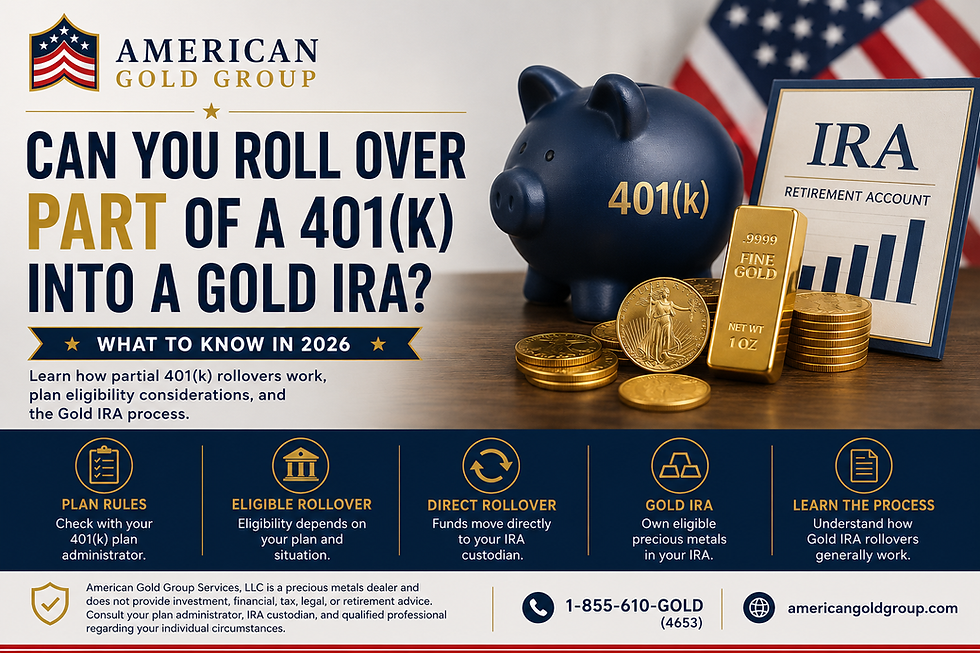
A direct rollover generally involves an eligible retirement-plan distribution being sent directly to another eligible retirement plan or IRA rather than being paid to the individual.
A typical process may involve the following:
1. Contact the Former Employer’s Plan Administrator
The plan administrator can explain whether a distribution is currently available, whether it is eligible for rollover, and what documentation is required.
2. Establish the Receiving IRA
If an individual independently decides to establish a self-directed IRA, the receiving IRA custodian provides the account-opening documents and its requirements.
3. Complete the Rollover Documentation
The former employer’s plan administrator provides instructions for requesting an eligible rollover distribution.
The receiving IRA custodian provides the information necessary to identify the receiving account.
4. The Eligible Funds Are Sent to the Receiving IRA
In a direct rollover, the eligible amount is generally sent directly to the receiving retirement account rather than being paid to the account owner.
5. The Account Owner Directs Subsequent IRA Transactions
After funds are available in the self-directed IRA, the account owner can provide instructions to the custodian concerning permitted transactions.
If the account owner chooses to purchase eligible precious metals, the IRA custodian and precious metals dealer perform different roles in completing the transaction.

Direct Rollover vs. Receiving the Distribution Yourself
These two methods should not be confused.
With a direct rollover, an eligible distribution is sent directly from the retirement plan to the receiving IRA or other eligible retirement plan.
Another method can involve a distribution being paid to the individual, followed by a rollover within the applicable time period.
Different withholding and tax rules can apply when retirement-plan funds are paid directly to the individual.
Because tax consequences depend on the transaction and individual circumstances, questions regarding taxation or withholding should be directed to the plan administrator or a qualified tax professional.
Not necessarily.
Federal rollover rules can permit all or part of certain eligible rollover distributions to be rolled over. However, the availability of a particular distribution depends on the terms and procedures of the employer plan.
Anyone considering a partial distribution should ask the plan administrator whether the requested transaction is available and how it would be processed.
For a more detailed explanation, see our guide:
Not every gold or silver product can be held in an IRA.
Federal law establishes requirements applicable to certain coins and bullion held by IRAs, including applicable fineness standards and statutory exceptions.
Depending on the particular product and applicable requirements, IRA-eligible precious metals can include certain qualifying:
Gold coins
Gold bars
Silver coins
Silver bars
Platinum products
Palladium products
Product eligibility should be confirmed with the IRA custodian before an IRA purchase is completed.

Where Are Precious Metals Held?
Physical precious metals purchased through an IRA are generally held under arrangements involving the IRA custodian and an eligible trustee or depository.
The metals are not treated the same way as precious metals purchased personally for direct delivery.
The IRA custodian can provide information regarding its custody and depository requirements.
Questions to Ask Your Former 401(k) Plan Administrator
Before initiating a transaction, useful factual questions for the plan administrator may include:
Is my account currently eligible for a distribution?
Is the distribution eligible for rollover?
Does the plan permit partial distributions?
What documentation is required?
Can the eligible distribution be sent directly to an IRA?
Does the account contain pretax, Roth, or after-tax amounts?
Are there outstanding plan loans or other plan-specific considerations?
How does the plan process a direct rollover?
Obtaining this information can help establish the plan’s requirements before a transaction is initiated.
Is Rolling an Old 401(k) Into a Gold IRA the Right Choice?
Whether to leave assets in an existing retirement plan, move eligible assets to another retirement plan, establish an IRA, take a distribution, or use another available option is an individual decision.
American Gold Group does not recommend that individuals move a 401(k) into a Gold IRA and does not recommend how much of a retirement account should be allocated to precious metals.
Precious metals prices fluctuate and transactions can involve costs and risks.
Individuals considering changes involving retirement assets should review the alternatives available to them and consult appropriate professionals regarding financial, retirement, legal, and tax considerations.
Get the Free Gold IRA Guide
Review educational information about Gold IRAs, eligible retirement accounts, precious metals, rollovers, transfers, and the purchase process.

Schedule a Call
Have questions after reading this article? Schedule a convenient time to speak with an American Gold Group representative about the general Gold IRA and precious metals process.
Learn About the Precious Metals IRA Process
For individuals independently researching a 401(k) to Gold IRA rollover, American Gold Group can provide educational information regarding:
IRA-eligible precious metals
Precious metals pricing
The precious metals purchase process
The role of the precious metals dealer
Delivery of IRA-owned metals to an applicable depository
Questions concerning retirement-plan eligibility, distributions, IRA administration, taxes, or retirement planning should be directed to the appropriate plan administrator, IRA custodian, or qualified professional.
Related Gold IRA Guides
Important Disclosure
American Gold Group Services, LLC is an independent precious metals dealer and is not a financial advisor, investment advisor, tax advisor, fiduciary, broker-dealer, or IRA custodian. American Gold Group provides educational information regarding precious metals and precious metals IRAs and does not provide investment, financial, tax, legal, or retirement advice.
Precious metals prices fluctuate and may involve risk. Past performance does not guarantee future results. Retirement-account transactions are administered by independent third-party custodians and are subject to applicable rules and requirements. Consult your plan administrator, IRA custodian, and appropriate professional advisors regarding your individual circumstances.

Comments